Boat Detailing in Monaco: 7 Signs Your Vessel Needs Professional Care
L'équipe MBS — 2026-10-10
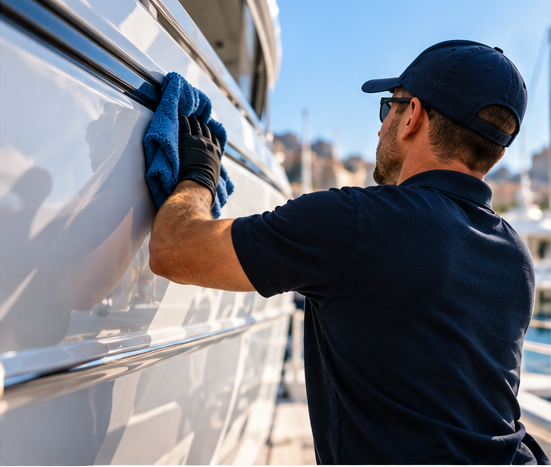
Your boat lives in one of the most beautiful marine environments in the world, and one of the most demanding. Monaco's salt air, relentless sun, busy harbor and warm Mediterranean water work on a vessel every single day. Most of the damage you eventually notice is the visible end of a process that started months earlier.
The good news is that a boat rarely needs rescuing without warning. It tells you, in small and specific ways, when it is ready for professional care. Here are seven signs that your vessel is due for expert detailing in Monaco - and what each one is quietly telling you.
1. Your gelcoat has gone dull or chalky
Fresh gelcoat has depth: when you look at it, you see gloss and reflection. When it starts to look flat, milky or chalky to the touch, the sun has begun breaking down the surface resin. Wax and sealants get stripped away long before you notice, leaving the fiberglass exposed to another season of UV.
This is the most common first sign of a vessel that needs help. A professional compound and polish removes the oxidized layer and restores the shine, then seals the surface so the protection lasts. Left alone, oxidation only deepens - and correcting it later costs more.
2. Salt haze films your hull and glass
Sea salt does not rinse off the way owners expect. It bonds to gelcoat, stainless and glass, leaving a stubborn haze that a quick hose-down will not shift. You notice it most on windows and windscreens, where clarity fades and every sunset looks slightly milky.
Professional detailing uses the right water and the right products to lift bonded salt without scratching the surface, and leaves a spot-free finish. Clear glass and a clean hull are not just cosmetic - haze on a windscreen is a safety issue when you are maneuvering in the harbor.
3. Waterline staining and scum lines refuse to budge
Look at the waterline after a few weeks in port and you will often find a brown or yellow stain, sometimes with a dark line of scum or faint exhaust soot. These marks sit exactly where your hull meets the water, and they are one of the clearest signals that a boat needs attention.
Waterline staining comes from minerals, exhaust and organic growth. It needs targeted stain removers and careful technique so the antifouling beneath is not damaged. When it is handled properly, the waterline comes back crisp and the hull looks cared for again.
4. Your teak decks have turned grey and rough
Teak is beautiful when it is maintained and unforgiving when it is not. Sun and contaminants strip the natural oils, and the deck slowly turns from warm honey to a flat grey. Run your hand across it and you will feel the grain lifting and roughening.
Grey, rough teak is more than a look. Raised grain catches feet and clothing, holds dirt and moisture, and invites the deeper problems that shorten a deck's life. Professional teak cleaning, sanding and oiling bring the grain back to a smooth, protected finish - and protect a feature that buyers notice first.
5. You can smell mildew below deck
Step into the cabin after a week away and a stale, damp odor greets you. Mildew and damp collect in cushions, headliners, lockers and carpet, especially after humid Riviera summers. If you have started leaving the hatch open "to air it out," the problem is already there.
Interior detailing addresses the source, not the smell: surfaces are cleaned, soft furnishings treated and ventilation restored. Your guests should step aboard to the scent of clean, conditioned air - not the reminder that the boat has been closed up for weeks.
6. Stainless and metal fittings have lost their shine
Stainless steel on a boat is under constant attack, and the first signs are small: tea-colored staining, tiny pits, rust streaks running down from a fitting. These marks are cosmetic until they are not - pitting weakens the surface, and rust trails stain the gelcoat below.
Polishing and protecting the metalwork restores the finish and slows the cycle. It also gives a trained eye a chance to spot the early signs of electrolysis, which is far cheaper to address now than after a fitting fails.
7. Grime is creeping into the places you never see
Bilges, engine rooms, lockers, under consoles, behind panels. The hidden spaces on a boat collect dirt, oil and salt, and they are the first place problems hide. A faint leak trail or a patch of corrosion under a hatch is easy to miss - until it becomes a repair.
A thorough detail covers the whole vessel, not just the visible topsides. Cleaning these spaces reveals small issues while they are still small, and keeps the boat genuinely healthy rather than merely presentable.
What these signs really add up to
Each of these seven signs is a small warning, and each one doubles as a reason to act now. Together they describe a boat that is spending more time battling its environment than enjoying it - exactly the situation Monarch Boating Services exists to prevent.
Professional detailing in Monaco is not a luxury for special occasions. It is ongoing protection: UV defense for your gelcoat, corrosion control for your metalwork, value preservation for your teak, and a vessel that always looks and feels ready for the water.
Monarch handles it all as a discrete, fully insured service, available as a one-off booking or a monthly subscription that keeps your boat cared for without you managing a thing. Enjoy your boat. We will take care of the rest.
Explore our boat care and maintenance services or ask about a subscription to keep your vessel in flawless condition all year round.